Friday, October 31, 2014

Are you a Chinese redneck?


Thanks to WeChat (China's hottest social media) and a fairly decent grasp of written Chinese, my eyes have been opened to a whole new world of insights. I can't help but want to share some of them because they really shed light on Chinese pop culture.

I recently wrote a post about Chinese beauty standards. In that post, I explained the different tiers of women based on weight and one of the Chinese words within the original post that I struggled to translate was diǎosī (屌丝). There are some similar terms in English used to describe a certain subset of the underclass such as redneck (in the US), chav (UK), and bogan (Oz), but none of these words exactly capture the essence of what a diǎosī exactly is. I tried asking Ming, but being the old man that he is, he didn't even understand what it meant in Chinese, let alone how to translate it into English. I guess I should cut him some slack because it took me a while to figure out what twerking and catfish meant. Once out of high school, slang is a tricky thing to keep up with.

Diǎosī is a fairly new word in the Chinese lexicon and keeps popping up all over the internet. Today I was finally able to get a better grasp on the word, thanks to a friend's post on WeChat. I realized that Ming and I are both very much diǎosī, Chinese rednecks, by the standards outlined in said post. Check out if you match any of the criteria (translated into English below):

Illustration of two diaosi. photo via weixin

For men:
1. Your entire wardrobe costs less than 1000 RMB (US$150).
2. You only drink baijiu (Chinese liquor made from sorgum) or beer.
3. You wear clothes from 361 degrees or Jeanswest (Chinese brands a step below their foreign equivalents of Adidas or The Gap).
4. You had less than three girlfriends before getting married.
5. You drink Kangshifu (ordinary Chinese brand) green tea.
6. Your annual bonus is less than 10,000 RMB (US$1500).
7. Your cigarettes cost less than 20 RMB (US$3.50) a pack.
8. Your car cost less than 100,000 RMB (US$15,000).
9. You haven't taken a real vacation in several years.
10. Your shoes cost less than 800 RMB (US$130).

For women:
1. You haven't changed your hairstyle in the last 6 months.
2. You have a resting bitch face (don't dare give a sexy pout).
3. You've never bought a bikini.
4. You don't wear sparkly nail polish.
5. You don't wear matching panty sets.
6. You've been struggling to diet for the past five months.
7. You like to walk behind your man(?).
8. You don't like looking in the mirror.
9. You don't wear shoes with more than a 5 cm (2 inch) heel.

According to this list, many people I know, both foreign and Chinese, are diǎosī. It seems to encapsulate your run-of-the-mill middle class adult. I do find it interesting that men's standards focus on finance and women's more on appearance. However, I don't find being a diǎosī anything to be ashamed of. I guess I could make more effort to be more of a girly girl and have my under garments match, but now that I'm in my 30's my sparkling nail polish days are over.

The good news, even if you are a Chinese redneck, you probably aren't an American one. The checklist for that is much harder for the average person to accomplish (and to understand, for that matter).

Are you a diǎosī (Chinese redneck)? Do you have a similar term where you are from? Do you find this kind of thing offensive or funny?

Thursday, October 23, 2014

Preparing for a long winter

Leeks drying outside (with trash collectors in background)


My favorite season is here, but soon it will give way to Chengde's sub-zero winter. Having grown up in a place with long, cold winters, I actually don't mind winter here that much. My hometown is, in fact, the second coldest major US city, beaten out only by Minneapolis. As anyone from a cold climate can attest, before winter, it is important to prepare. First prepare your state of mind. Seasonal depression is for real. Next, get out your snowblowers, salt, plows, tire chains, boots, ice auger, and snow shovels—you're gonna need them. Most importantly, be sure to have some money put aside for your heating bill. Keeping warm is not cheap.

more leeks

As opposed to the US where heating is paid monthly by usage, in China the price is calculated by the square meter and it's paid for upfront. We just paid ours last week. Our 63 square meter apartment (680 square feet) cost 1500 RMB (about US$250) to heat for the winter, half of which we'll be reimbursed for by Ming's work. Unfortunately, we have no control over when the heat will be turned on, though it is usually the first week of November. We also don't get to dictate the temperature. While I am now anxiously anticipating the arrival of indoor heat, I don't dare complain too much, as the situation in southern China—any place south of the Yangtze River—is far worse. People don't have indoor heating. Southerners have to get by with space heaters, air-conditioners (they have a heating function, who knew this was possible?), and many layers of clothes.

drying cabbage

In addition to paying the annual heating bill, I've noticed people doing other things to prepare for winter. These days, everyone seems to be heading to the grocer's to stock up on leeks and cabbage. I am afraid to visit the supermarket lately because the entire vegetable section is overrun by elderly women filling their carts with bundles of leeks. Every direction I look there are people drying out vegetables for the winter. Ming and I have never bothered to do this. I wonder if anyone under the age of 50 even bothers. I understand the desire to save some money, as the price of veggies obviously peaks during winter months, but I'm not sure if the cost soars high enough to warrant this kind of hoarding.

I just thought this was cute.
Another sure indicator that cold weather is setting in is long underwear (thermals). Despite being from a cold weather climate, I never owned a pair of long underwear before coming to China. My understanding was that long underwear is the sort of thing for ice fisherman and snowmobilers, people who are winter sports enthusiasts. In this part of China, thermals are the very foundation of a person's wardrobe from September to May. If you aren't wearing them, prepare for a verbal thrashing. Only an idiot would be caught without this essential layer of warmth. I am a convert; I wear them all the time now, both indoors and out.

What about you? Do you do anything to prepare for winters? Or are you lucky enough to live in a place without winter?


Monday, October 20, 2014

A not-so-fun run


2014 Beijing Marathon, photo via weixin

Yesterday was the annual Beijing Marathon. As anyone in this corner of China can attest, the air pollution has been stifling the past couple days. I'm hesitant to open my windows or go out, so braving a 26-mile run sounds downright ludicrous. I don't know how people's lungs can cope, though people certainly try. The pictures of participants show a large array of face masks (some resembling gas masks) were used to combat the hazardous air. Check out some interesting photos on this Chinese article. 

In the sprit of the Bei Ma (as it's called in Chinese), I thought I'd write a little about my own experience running in China. Me? Run? I know it comes as a shock. Given my body type (chubby hamster), it may come as a surprise to some that I enjoy running. I've gone through spurts of running and jogging since joining my middle school cross country team in 7th grade.

Although I don't have a bucket list (they seem to be all the rage these days), if I did, running a half marathon would be on it. A few years ago I began a training regiment in anticipation of attempting a half in the Beijing Marathon. Being pathetically out of shape, I was giving myself eight months to prepare, with a couple races leading up to it. The first being the Zheng-Kai Marathon in March.

The concept of the Zheng-Kai Marathon is pretty cool if you are up for running a full marathon; it starts in Henan's capital of Zhengzhou and you cross the finish line somewhere in the historic city of Kaifeng. But that was well beyond my ability. Having only been jogging for several weeks leading up to the race, I settled for running in a 5k (about 3 miles) in Zhengzhou. In addition to the 5k and marathon, there was also the option for 10k or half marathon, but I figured to take it easy in my first race. I signed up for the race and paid the fee online (45 RMB, a steal compared to high profile races like The Great Wall or Beijing Marathon that can cost well over US$100).

I picked up my pack the day before the race with instructions to check-in for the race two hours prior to the start time. When I arrived the next morning, I was amazed at the number of people waiting to participate. I later found it was approximately 10,000 in the 5k alone. To my dismay, we didn't actually have to check-in for anything. I only had to find a place to put my pack and then pin my number to my shirt. After getting situated, I spent the next hour and a half chatting with a race volunteer (of which there were many) and then chatting to a group of local teens who were participating in the race.

At last the time came and we began to assemble by the start line. Due to the large number of runners, I was nowhere near the start line. In fact, after the gun sounded, it took me 10 minutes just to reach it! The biggest problem may not have been the number of people, however; it was probably the sheer lack of organization. Many of the participants were walking the race, but they were mixed amongst runners. It was incredibly difficult to get passed them in the beginning of the race. A lot of the walkers and some of the runners carried large banners, sometimes held by multiple people. I also saw men carrying their girlfriends and adults carrying toddlers. I guess no one cared that children under age eight were restricted from joining the race. Rules are meant to be broken, right? And broken they were. Despite the volunteers manning the race course, people found shortcuts in the course, taking them at liberty. Garbage was strewn everywhere, including hundreds of yogurt containers (yogurt, why yogurt?) that must have been passed out to the runners who leaded the race. I only managed to see one kilometer marker (for kilometer 2) on the course. As I neared the finish line, I wanted to break into a sprint, but couldn't—there were too many walkers ahead of me. When I finally finished the race, over 50 minutes since it began, I was tired and incredibly frustrated.

My first real race was a letdown. I wondered if subsequent races in China would be as chaotic. Unfortunately, I've yet to find out. Shortly after the Zheng-Kai Marathon I came down with the flu and then the heat of summer hit and I never got back into a proper running routine. I still hope that one day I'll properly train for and achieve a half marathon, but I don't think it's going to happen in China. Looking back at my 5k experience and pictures of yesterday's marathon, I guess it might be for the best. I might have better luck when we return to the States.

 not your ordinary face mask, photo via weixin

Wednesday, October 15, 2014

No Perfect Goddess


I've never been thin; in fact, I am overweight and have been since childhood. It's a painful admission as I feel like it is a character flaw. Though I don't eat poorly and I walk daily, I should be eating better (no more chocolate, no more chocolate, no more chocolate) and exercising more (specifically: sit-ups and whatever gets rid of flabby underarms).

In America, we like to dance around the topic of being overweight. Don't call people fat—they are heavy. Curvacious. Bootilicious. Big Boned. Whatever. No one likes to be fat; it means you are lazy and gluttonous and worst of all, ugly. In China, it seems to mean something different, though I'm still trying to understand what. People use the word fat so freely here that it doesn't seem to carry the same weight of an insult as in my homeland. I've wrote about this a bit before. But whatever the intended meaning—good, bad, or neutral—the word stings when I hear it, though I hear it less and less lately.

Being overweight, being fat, is the new normal in eastern China. Still, women strive to svelte. Dieting is popular, though it takes a different form than what I'm used to. There are weight loss coffees and teas, but other common techniques include cutting out all meats and skipping meals. No Atkins, no South Beach, no Paleo. I don't know if any of this is very effective. I've always found exercising and restricting oils and sugars to be most helpful, call me old-fashioned. Unfortunately, even during my most disciplined dieting days, I never was able to achieve what you'd call skinny.

Yesterday I came across a very helpful chart posted by a Chinese friend on WeChat (for those who don't know, WeChat is the current Chinese social media of choice that is like facebook, twitter, and skype wrapped up into one). Anyways, here's the chart:


Vertically, you find your height in centimeters. For example, I'm 5'4'' which equals about 163 cm, we'll round down to 162. The numbers within the chart are all in Chinese jin (which equals half a kilo or 1.1 pounds). Horizontally, at the top, you will see three different categories, under which is a figure of weight in jin. The category on the left represents a “Perfect Goddess Figure.” In the middle, you have something loosely translated as “Ordinary Pudge” (correct me, fellow Mandarin readers, if you can come up with a better translation) and to the right is a full out “Chubster” which is sometimes illustrated by images such as the chubby hamster below:


I am well, well into the Chubster category. In fact, according to this chart I need to weigh about 100 pounds to consider myself a true goddess. I haven't been a goddess since the 4th grade then and I fear I will never make it down to 100 or even close. Maybe I should feel bad about this, but I don't. Not really. I know a lot of Chinese people believe that a woman should never top 100 pounds, but I can't imagine myself, or most of my western female friends, being that thin. I rather not get too hung up on the numbers. At this point, I would rather be healthy and happy than a teeny, tiny goddess.

Tuesday, October 14, 2014

Six Months (and more lessons learned)

At Giraffe Cafe with William

We've made it to six months! In the beginning, it felt like William would never grow up. I struggled a lot with the newborn stage, but now I can hardly remember those days. Time really passes quickly and it's remarkable how fast babies change. I'm trying to enjoy what's left of the baby stage; before long, William will be a toddler. These days, he is busy learning to roll around and sit up. He's experimenting with lots of different noises, primarily mama, baba, dada—which means he's already well on his way to being bilingual!

I've learned a lot in the past several months. I've learned about the intricacies of my relationship with China, with my husband, and with my mother-in-law. I understand things now that I never fully grasped in all my nine years of living here. I see my own Americanness and perhaps the stubbornness that goes with it. I am working hard on accepting that there is more than one right way to do things. I am also realizes that what works in America doesn't always work in China.

I had a bit of a revelation last week. After months of feeling picked on. After months of feeling like Ming and his mom were watching my every move. After months of assuming I could do nothing right. I finally got it. I have to stop viewing it as My American Way vs. Their Chinese Way. We all have different ways of doing things and personal preferences. It's not about being right or wrong. It seems like the most obvious thing in the world, but I was so wrapped up in being on the defense that I failed to see the situation clearly.

I'd like to go into details about all the silly bickering and beliefs that brought about my change of heart. But I think this time I'd better just let it go. Before long we will be back in the US and the tables will turn. I will be in my comfort zone and surrounded by people who share in most of my daily habits and reinforce many of my cultural beliefs. I need to remember what it's like to be the outsider. Compromise and compassion are really important, in any family, but especially in a cross cultural one.


Monday, October 06, 2014

A New Addition to the Family

Mama and William with the new baby.

William has a little sister! Ming's cousin's wife, Meng Meng, gave birth to a little girl on October 1st, which, coincidently, was the Chinese National Day. Several babies were born at the hospital that day (the same one where I gave birth), which is more than the usual one or two a day they average, indicting that some mother's chose the first of October as a lucky day for their cesarean birth. Meng Meng gave birth naturally, 22 days early, to a healthy daughter weighing in at just under 6 pounds.

While the little one, who is yet to be named, is technically William and Ping's second cousin, they both will refer to her as mèimei (little sister). William has already been dethroned as the youngest and has now earned the title of the baby's gēge (elder brother) while Ping, as the oldest of her generation, continues as jiějie (elder sister).

Learning all the Chinese names for familial relations is complicated. In fact, in Mandarin, there are eight words (or more?) for cousin depending on if said cousin is male or female, elder or younger, paternal or maternal. Perhaps knowing the word for cousin doesn't really matter, however, since many cousins are considered brothers and sisters. When I first came to China I found this very confusing. All my students would tell me about their numerous “brothers” and “sisters;” I didn't understand how so many people could have siblings in a country with a one child policy. Turns out, most of them were talking about their cousins.


looks like they like each other


At first, I didn't know what to call Ming's cousins, but since I'm married to the eldest male cousin, I simply call them by name. They, on the other hand, respectfully call me sister-in-law (sǎozi). All of Ming's relations are on his mom's side. We refer to his mom's older brother as big uncle (dàjiù) and his wife is big uncle mother (dàjiùmā). We call her younger brother second uncle (èrjiù) and his wife is. . . you guessed it. . . second uncle mother (èrjiùmā). There are several words for aunt in Mandarin, but Ming's aunt goes by lǎo yí (which, literally translated, means “old maternal aunt”). There would be completely different terms for his aunts and uncles if Ming had paternal relatives.

Is your head spinning yet? Well, don't worry. Here is a good post about common vocabulary for Chinese family with a "Chinese family tree" link to download. When in doubt, it's probably best to check what to call people. There are a lot of variations.

Saturday, October 04, 2014

My mother-in-law


I feel very fortunate. If there was an award for best stepmother, I would nominate mine. But it doesn't end there, if there was such an award for mothers-in-law, I would throw her name in, too. How many people can say that?

A person's relationship with her mother is tricky, with one's stepmother (if she has one) is even trickier, and the relationship with her mother-in-law, well, that's often stuff of nightmares. From what I've heard, Chinese mothers-in-law are a particularly thorny breed, as traditionally they reigned above the household. I've read some interesting blogs posts about Western women and their m-i-ls, my favorite includes Jocelyn's post on her blog Speaking of China; the comment section in particular elicited a spectrum of emotions in me—from anger to fear to sadness, but mostly just gratitude that I haven't had to deal with the in-law headaches most women speak of.

Why is my mother-in-law so great? Clearly, we have our differences; I've written about a few (such as an old, snarky post on spitting on the floor at TGIFridays and more recently, only allowing warm food and beverage while breastfeeding). At the heart of things, she is very open-minded and has always accepted me. It's not easy to accept that your child is marrying a foreigner, my own parents had their own concerns about this in the beginning. With the occasional exception, she doesn't lecture me for not doing things The Chinese Way. She also does the chores that Ming and I hate and mostly refuse to do, such as cleaning the stove. For that alone, I'd like to nominate her for sainthood.

I think part of the reason Ming's mom is such an easygoing mother-in-law is because she never had a m-i-l of her own lording over her. Historically, there seems to be a cycle of abuse, passed down from one generation of Chinese women to the next. Since each woman had to endure the torment of her husband's mother, she eventually feels the need to even the score by mistreating her son's wife. Ming's paternal grandparents died around the time of the Communist takeover of China, leaving his dad an orphan. Ming's mom never met any of her in-laws and Ming has never had contact with anyone from his Dad's side of the family, which come from far off Sichuan Province. Because of this, for better or worse, Ming's mom has never belonged to any family but her own.

But being without in-laws isn't the real reason for her greatness. My m-i-l has a great personality. This is clear through her myriad friends and her ability to always find a boyfriend despite the disproportionate amount of elderly women to men. Since having William, we've had the chance to spend an awful lot of time together. It's been a great chance to bond over the baby and get to know her more intimately.

Spending so much time together also provides a glimpse of what the future may look like for us--for her help and kindness are not a one way street. One day, when she is too old or too lonely, we will most likely take care of her and live together. This is often part of the deal when one marries into a Chinese family, which is different from most American families I know. I long ago accepted the idea and now have even grown to like it. While merging different generations and personalities together can sometimes be challenging, it's nice to know we can all lean on each other through our difficulties.

How about you? Do you ever imagine taking care of your parents or in-laws when they are old? How do you think you'll get along?


Ming, Ping, and my m-i-l, circa 2010


Wednesday, October 01, 2014

Nail Houses


When I was in first grade, one of my classmates, Mike, was changing schools. He had to move due to eminent domain laws. My parents explained to me that Mike's house was on land other people needed. They were going to use that land for constructing several commercial buildings. His family was given money so that they could move somewhere else since their house would soon be demolished. I thought the whole situation sounded terribly unfair. I couldn't imagine having to move from my own home and start a new school because someone else decided they wanted to knock our house down and build something else in its place.

After Mike, I hadn't come across anyone affected by eminent domain. . . and then I came to China. Anyone who has been here knows that you can't go far without stumbling on something being knocked down or something being built up. This out-with-the-old-and-in-with-the-new mentality has caused a new phenomenon—nail houses. If you don't know what nail houses (钉子户dīngzi hù) are, you should check out this article. The pictures will give you an idea! Nail houses are particularly common in China, though they do occur in other countries, even the US, as shown in this article.

Aunt's house, 2007

In China, homeowners may refuse to move despite their property being snatched up by the government or private developers. Some stay because they simply don't want to leave. Most, however, hold out on selling their homes in hopes of scoring a better deal as developers get more desperate for the property their home is on. Sometimes this plan backfires, as has happened to owners in a dilapidated apartment complex near my home. Most of the apartments are empty, but others still have occupants, those nails who initially refused to move, but are now stuck in the crumbling abode since money for the developing project ran out.

door frame and rubble
For others, things work out quite well, as was the case for Ming's relatives. Ming's uncle (his mom's younger brother) and aunt (mom's younger sister) both had houses on property that was being developed. Their homes were simple, one story houses with small courtyards—the kind of homes you typically encounter in the Chinese countryside. Quite frankly, the living conditions were poor, without indoor plumping or adequate heat. They were conveniently located near the city center by Chengde's Summer Mountain Resort. In 2007, before Ming and I went to the US, we visited his aunt's house and found that everything (with the exception of his uncle's home and the public toilet) was rubble. When we returned the next year, they still remained. I don't think they moved until the end of 2008, more than a year after all their neighbors had moved. They made out quite well, scoring two brand new apartments per family, plus cash. In the span of a year they went from dirt poor to having brand new flat screen TVs and big, plush coaches. To this day, I'm not sure how to feel about it—happy that they were lifted out of poverty or, dare I admit, jealous that they got all new stuff.

Have you heard stories or personally know anyone affected by new development? What do you think is the most fair way for the government and developers to deal with this?

Sunday, September 28, 2014

China: Virgin Only Territory?


Sex. Perhaps a topic on which I should tread lightly—not only because it's taboo, but also because I am no expert. I wrote about it once before and it's been weighing on my mind again lately thanks to some interesting blog posts I've read (a recent one on Speaking of China and an oldie but goody on a great China blog I discovered: Laowhynot) as well as due to a rather disturbing discussion I had with a student last weekend—more on that later.

There are lots of different stereotypes about foreigners in China, notably that we are sex hounds with insatiable sex drives. Since I'm married, I rarely have to deal with the problems that come with being perceived as such. Ming has shared some of the locker room talk he has with his male co-workers and (although I'm sure he somewhat sensors it), it sounds fairly innocuous. He faces a few rather benign questions about his sex life with a foreigner. Mostly, he just tells people it's none of their business. I guess it's not, though I understand why people are curious. Though people everywhere are generally the same: they have family, they eat, they have friends, they work, they have sex. It's the attitudes towards these things which sometimes vary greatly.

photo by popawilli via Photobucket


Even in modern China, I feel like attitudes toward sex and dating are a bit backwards. While the situation is certainly changing, double standards abound. Most notably, young women are often expected to save themselves for the man they intend to marry. One of my close Chinese friends exemplifies the situation perfectly.

Firstly, she feels I am one of the only people she can openly talk to about sex. She admitted that even in conversations with her closest Chinese friends, the topic is skirted around. As a 20-something woman, she afraid to even admit she's had sex. She was most afraid to admit this to her mother, but after having dating the same man for five years, the truth finally came to light. The true injustice of things surfaced once her and her boyfriend broke up. Her mother marked her as damaged good's, proclaiming that if she wanted to get married she'd “have to settle for a divorced man.” Evidently, only virgin females get to marry single Chinese males.

Of course, a lot of Chinese people see the unfairness. My oldest student, a 17-year-old high school girl, actually brought the topic up. She is frustrated by the double standard and told me that lately it's been fervently debated online. Many people support women's sexual freedom, while others make wild claims that it is a woman's duty to remain a virgin for her intended husband. Why? According to my student, some netizens are arguing that when a woman sleeps with a man, part of his DNA is left behind. When the woman later become pregnant, the DNA of all her past lovers is passed on to the fetus. Whaaaaaaat? And the rationalization for wanting a virgin wife continues on. . . 

What are attitudes like in your country? Do you think there is a double standard when it comes to sex and gender?

Thursday, September 25, 2014

Turning into my parents

Back when she was still a little girl.
First day of 1st Grade, Sept 2010.

It inevitably happens to most of us at one point or another. . . we turn into our parents. We start doing things that we swore we would never, ever do. I don't consider myself much of a nag and I have aspired never to become one, yet I feel myself slowly descending into a hectoring mother who is constantly complaining and never satisfied. The kind of mother that, as a child, you don't look forward to coming home to. I'm still trying to figure out what kind of mom I want to be, but I do know that I don't want to be that mother. But now the Ping has become a tween, I'm having difficulty getting my bearings on who I am as a parent. She is no longer a cute, adoring child, but is morphing into a grown person with her own ideas about the world and her need to establish independence.

This age is confusing for all of us. Somehow stuck between being a kid and a grown-up, it is difficult to find a balance between teaching her how to become more of an adult yet accepting that she is still, in a lot of ways, just a kid. My difficulty is compounded by the fact that we speak two different languages. I can't always express myself properly so instead of explaining why something must be done, I have become of a broken record of simple commands, “Stop,” “No!” and “Don't do that.”


Another issue I keep running up upon is that, even after nearly a decade here, I still don't always understand how things are done in China. Yesterday Ping came home from school, informing her grandma that she needed 340 rmb (about US$60) for school books, to be paid in cash the next day. When Ming's mom relayed the information to me, I didn't think to question it—though the amount did seem a bit high. Chinese students constantly come home shaking down their parents for money to buy stuff their teacher demands. In the US, we would be given a notice and breakdown of anything we need to purchase for school with ample time to scrape the money together.

I like the US way; it eliminates some of the guess work. In China, I'm still a rookie at trying to figure out where half my money is going. You could go so far as to call me naïve. Ming knows better than I. When it comes to Ping or anyone else, he gets a rundown on what money would be used for, being sure that each RMB is accounted for. I assumed, perhaps foolishly, that Ping wouldn't ask for more than what was needed. It turns out that some of the money was going towards (optional) magazine subscriptions the children can purchase. A purchase, Ping knows (I thought she knew?), she must discuss with us before making.

Another issue we are dealing with is safety. Back in the US, parents worry about things like “stranger danger,” keeping our kids safe from pedophiles and predators. In China, we do need to protect our kids from strangers, yes. Children get kidnapped from time to time. But just like in the US, I think incidents of random adults stealing or hurting kids are somewhat rare. A more immediate danger is what kids are putting into their bodies when their parents aren't looking. I'm not talking about sneaking chocolate chip cookies or potato chips, (which I did every chance I could get when I was little), but buying food from unscrupulous vendors outside the school gates. Near Ping's school there are dozens of vendors and small shops catering to kids. They sell cheap snacks, often deep fried, and of rather dubious quality. The odds that many of them are using spoiled or expired food are high. Despite Ming's warnings, Ping can seem to help herself from purchasing these dirty delicacies. The results are often a very upset stomach.

What to do? I'm trying to figure it out. I'm also making a conscious effort to be a better, more understanding mother. What about you, do you find that you are in some ways starting to act like your own parents? Does it bother you?

Sunday, September 14, 2014

A Taste of Chengde

Chengde's Little Potala Palace


I had the chance to visit a friend of mine in Beijing recently. While I was there we chatted with a few locals, mostly taxi drivers—they are among the best people to practice speaking Chinese with—who were interested in why us foreigners were in China. I have my standard answer, that my husband is Chinese and from nearby Chengde.

inside the Summer Mountain Resort

Over 300 years ago, the Kangxi Emperor chose Chengde as his place for summer residence. Thanks to Chengde's cool summer temperatures (well, at least compared to Beijing) and beautiful scenery, it seemed like a good pick. Construction of The Summer Mountain Resort, which is 2.2 square miles (that's 5.6 square km for my metric friends), took about 90 years. It is filled with palaces, gardens, pagodas and lots of other good stuff. Locals, especially the elderly, congregate there every morning. In the summer, especially on the weekends, it is packed full of tourists, many of them from Beijing.
Chengde's Little Potala Palace
Upon hearing Chengde, they all inevitably exclaim, “The Summer Mountain Resort!” (避暑山庄bìshǔ shānzhuāng in Mandarin, literally meaning “avoiding the summer heat mountain villa” in English). Many Chinese people and probably just about every Beijinger know Chengde thanks to its biggest tourist attraction. The Summer Mountain Resort is a UNESCO World Heritage Site along with Chengde's Eight Outer Temples. I must admit, I feel a tiny burst of pride that I get to live in a place that holds an important place in Chinese history.


downtown Chengde
The Summer Mountain Resort is nice, no doubt, although I don't think its 120 rmb (US $20) entrance fee is justified, especially since Beijing's similarly splendid Summer Palace only costs a fraction of that. Luckily, I can get an annual local pass for unlimited visits for the bargain price of 50 RMB. What I really like about Chengde is the surrounding temples, particularly the mini Potala Palace (also known as Putuo Zongcheng Temple in English and 普陀宗乘之庙pǔtuó zōngchéng zhī miào in Mandarin). It is modeled after the Potala Palace in Lhasa Tibet and is one of the largest temples in China. If temples are your thing, this one is definitely worth visiting.

But the biggest benefit of living in Chengde is the small city atmosphere. I do love Beijing, but living there was often hard. As with any big city, life moves faster. People aren't always as personable. Commuting can be torturous. Pollution often paints blue skies gray. Life in Chengde is simpler and people are usually kind. Some people may find it boring here—there's no Starbucks, few bars, and hardly any other foreigners—but I've come to enjoy living in a small Chinese city surrounded by mostly Chinese things.
Chengde backstreet 

When people back home ask what it's like living here, it's hard to explain. In some ways, life isn't so different as life back home, but I guess the differences are in all the little details. The temples dotting the mountains, the fortune tellers that hang out on the sidewalks, the middle-aged ladies dancing outside in the evening, and the peddlers who come around every morning screaming their wares and services. Pictures can only begin to capture a place, but I thought I'd post some photos of Chengde for those interested in what this small Chinese city is like. Enjoy! 


the city square and mosque

Thursday, September 11, 2014

Teacher's Day

Luna playing the guzheng

Yesterday was Teacher's Day. I don't know whether or not it is an official international holiday, but it joins the list of widely celebrated holidays in China that seem to go unrecognized in the US (others include Women's Day and Children's Day). I remember my first Teacher's Day well, as it is often hard to forget painfully embarrassing experiences. At the time, I was working as a high school English teacher here in Chengde. The day before the holiday, my boss approached me in the teacher's office, right as I was getting ready to leave work. She wanted me to prepare a performance for the next day's teachers' assembly. “What kind of performance?” I asked. “Oh, anything will do—you can sing or dance or play an instrument,” she replied casually. My heart jumped up into my throat. As anyone who knows me can attest, I can't sing or dance or play anything. I'm more of the artsy fartsy variety.

Looking back, I should have protested. I should have refused. I should have made up any excuse to get out of such an impossible situation. But I was a naïve. I was a good sport. And I ended up looking like a complete idiot attempting to sing the ever-so-popular song (which I'm sure no one outside of Asia has ever heard of), Michael Learns to Rock's “Take me to Your Heart.” I did it accapella and I forgot the words about 15 seconds into my performance and ran off stage. Happy Teacher's Day to me.


me with Luna's family, on stage

Fast forwarding nine years later, yesterday was marked by another performance, luckily not by me. This Teacher's Day I had the honor of watching one of my students perform. I've been tutoring Luna since she was a little girl, nearing six-years-old. Although she is now not quite 12, she has grown into a pre-teenage girl that nearly resembles a woman. She is taller than me, for sure. But her dedication and maturity rivals that of many grown-ups. In just two years, she seems to have mastered the guzheng (a traditional Chinese instrument similar to a zither). I was stunned that she got to headline her own concert, but the opportunity was well deserved. Luna played beautifully.

Luna with her 6th grade classmates
Sometimes I feel a bit shy to admit that after all these years in China, I still work as a teacher. It seems to be a job that most foreigners grow out of after a year or two. Somehow you haven't really “made it” in China if you don't move on to other things. But yesterday helped me remember why I'm glad to still be a teacher. It's amazing to see the kids I tutor transform, not just in their ability to speak English, but also to see them mature and develop their personality and abilities. I also feel respected and appreciated by many of my students and their parents. Yesterday Luna's mom and dad expressed very heartfelt gratitude toward me. I like to think I played a small part in advancing Luna's education and I hope she remembers me fondly when she's grown up. I know I had a lot of great teachers growing up and I feel very fortunate for that. To all the teacher's out there, Happy (Be-lated) Teacher's Day!

Monday, September 08, 2014

Mid-Autumn Festival 2014

a variety of moon cakes I purchased at 7/11


Another year in China, another Mid-Autumn Festival. For those who live(d) in China, perhaps it needs no introduction, which is good because I actually know relatively little about this holiday. It usually falls in September and it reminds me a bit of Thanksgiving in the US as it revolves almost entirely around eating food with your family. But while Thanksgiving is marked by pumpkin pie, no Mid-Autumn Festival is complete without moon cakes. 

moon cake set
(photo by emmachen via Photobucket)

Chinese people exchange these tiny little cakes, often in beautifully packaged sets, as shown above. They can also be bought individually at any supermarket or cake shop. Every place seems to market and sell their own unique cakes. The first photo shows a variety of moon cakes I picked up at a 7/11 in Beijing. These cakes break from tradition a bit. The animal-shaped ones, which I got for Ping, are particularly special as they are to be eaten cold and are filled with fun flavors like blueberry and kiwi. Traditional moon cakes are round, the outside made of a golden crust and the inside filled with a paste such as red bean or lotus. The majority of moon cakes I've tried have been sweet, though sometimes the inside contains an egg. Initially, I wasn't particularly impressed by moon cakes, but they have grown on me. I like the five nut flavor, which I was told by one of my students is viewed as old-fashioned and only something old people like; I guess I'm not very hip with my moon cake preferences.

one of Uncle Zhang's sons with William
Unfortunately, Ming had to work today. I did get to celebrate the holiday, however, with my mother-in-law's boyfriend, Uncle Zhang, and his family. We had lunch together at Uncle Zhang's house, where my mother-in-law also lives. The food was pretty simple, but included a variety of home cooked dishes (made by Uncle Zhang and my m-i-l) and included foods such as sausage, quail eggs, stir fried green beans with pork, stir fried mushrooms and bok choy, and cold cucumber with tofu. The adults drank either baijiu or beer. The kids had kumquat (somewhat similar to orange) juice. We all took turns toasting each other as Chinese people do when they enjoy a large meal. At the end of the meal, those who weren't yet stuffed, filled themselves up with rice. I still find this practice strange as I can never find room for rice unless it is eaten with the dishes of food! 

Ping and Uncle Zhang's grandkids being silly

Honestly, Chinese holidays are sometimes hard for me. Though it has gotten easier over time, I struggle with understanding the traditions and in the past I didn't much enjoy the food. It can also stir up feelings of homesickness and make me long for American holidays. I will miss Thanksgiving in the US this year, but I am trying to make the most of the festivities in China. Before long, we will be leaving and will be missing things like moon cakes and baijiu toasts.

What about you? Have you experienced cultural holidays different from your own? What did you like or dislike about them?

some of the dishes we ate

Thursday, September 04, 2014

Make your own cheese

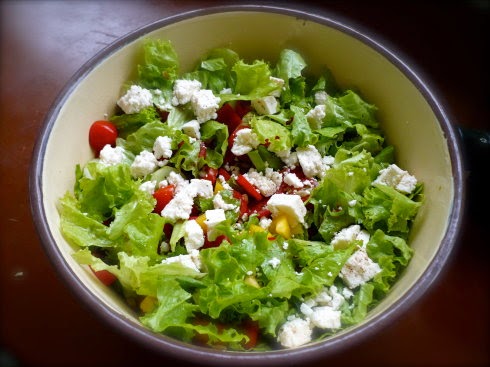
Home made cheese in salad
 I hail from Wisconsin, known in the US as “America's Dairyland.” We are famous for our spotted cows and all the milk, cheese, and butter they produce. Living in China, I find myself missing one food more than anything else—CHEESE! There are so many different varieties and I love them all. Unfortunately, decent cheese is both rare and expensive in Chengde, which made me get inventive. Why not try and make my own? It turns out it's actually easy to make a basic cheese. The following recipe will allow you to make your own, which resembles an India paneer or perhaps, if you are good at using your imagination, a Greek feta. It's probably best used to top a salad or pasta. If you are need of cheese and have a little time on your hands, give it a try!

Ingredients:
1 liter/quart of whole milk (not skim)
60 mL (¼ c) vinegar
salt and pepper

  1. Over medium heat, heat milk in a pot until it's about to boil. Turn off heat.
  2. Pour vinegar into milk and stir. Milk will separate into curds (solid) and whey (liquid).
  3. Pour entire contents of pot through a clean dish towel or cheese cloth. Fasten cloth shut and hang it for 30 minutes, allowing whey to drip out.
  4. Take down cloth and open up to remove curds. Put curds in a pan and then place another pan on top of the cheese. Place a heavy object on top of the second pan. Let sit for 30 minutes. Pressure will remove extra liquid and give you a solid piece of cheese.
  5. Remove cheese and cut into cubes. Sprinkle with salt and pepper, if desired.
  6. Store in fridge for up to four days.
Curds after hanging for 30 minutes.

Monday, September 01, 2014

Apartment Mishaps


I've lived in my fair share of apartments since moving to China back in 2005. And each apartment, perhaps with the exception of the one we live in now, came with a share of headaches. My first apartment was mine, rent free, thanks to my job teaching at the local high school. The windows were ancient, allowing wind and cold air to whip through during the frigid winter. The garbage shoot in the stairwell was a hangout for neighborhood rats. I left that apartment in the summer, expecting to return to it in the fall after vacation but instead I received an email from my waiban (foreign affairs boss) saying that all my things were being moved into another apartment while I was away as the previous occupant to my flat was returning. I did a mental checklist of all my belongings—anything odd, incriminating, embarrassing? Since I'm a pretty boring person, I quickly realized there had been nothing of the sort left behind. But then a bolt of panic rushed through me as I realized there was 4000 rmb (US$500, at the time) under my desk. I had never managed to open a bank account and that seemed as safe a place as any. Luckily, my boss paid me back the money that had been “lost” in the move.

A year or so later, Ming and I moved to Beijing. I was back in the US when “we” moved. Ming was saddled with the responsibility of finding us a place to live near the school I'd be attending. I figured he'd have no problem, being a 30-year-old man who spoke the local language, a skill I still hadn't managed to acquire. I assumed he'd have the know-how to apartment hunt even in an unfamiliar city. I was mistaken. When I arrived to Beijing, Ming was living in a one room shanty that housed a bed, table, and a very sad looking stool. If I wanted to use the toilet, I'd have to use a public one. You know the kind (if you've been to China), they are without stalls and are little more than holes in a concrete floor. I told him I'd hold my bladder until we found a McDonald's or a new apartment—whichever came first. And we did find a new apartment (and McDonald's) later that day. But it was a shared apartment, with a middle aged lady and her grade school-aged son. While the place was in our budget, it was far out of my comfort level. So we told the agency we needed something else and we settled for an over priced, roach infested palace nearby. Luckily, we upgraded to a cleaner, cheaper place within a few months.

Chengde apartment building
I'm glad the days of dismal apartments are behind me. In fact, I didn't think I'd ever have to rent an apartment again, especially in China. But as it turns out, we are now both owners and renters. In addition to the apartment we are living in (which we own), we are also renting the apartment across the hall from ours. Since it's hard to work from home with a small baby in a 62 square meter (680 square feet) flat, we decided it would be worth the money to rent a place for me to use as my office. While it is worth the money, I'm still trying to decide if it's worth the headache.

Despite being told that the place would come furnished, all we were left with by the former occupants was a bed, air-conditioning unit, and mop. We didn't even get a toilet seat—not sure what is worse, that they took the old one with them or just didn't use one at all. They did leave us a bathroom full of mold and mildew as well as a leaky toilet and sink. Ming and the landlord continue to bicker over who should pay for cleaning and repairs. I decided to take it into my own hands and scrub away at the mold. I'm not sure what steps to take in fixing the leaks. I've pretty much come to terms to the reality that I may be listening to dripping water for the next year.

Of course a new home is always full of surprises. The biggest one of all came yesterday when my friend, Marie, was in our rented space. We neglected to tell her how to get out of the apartment, which can require some finesse as Chinese doors often require an intricate knowledge of which knobs to push or pull while jiggling the key and pressing the door with just the right amount of pressure at a specific angle. Marie had no knowledge of the workings of our door, so she did what any overly confident foreigner would do and assumed she'd be able to figure out how to open and exit the apartment by herself. She was mistaken. With one simple wrong turn, she locked herself in the apartment. That particular lock was most likely rusted from years of sitting unused. After spending over an hour trying to get out of the flat without success, Ming had to jump from the neighboring apartment's balcony into the bedroom window to rescue Marie. After forcing the lock with the handle of a mop, Marie and Ming managed to escape unscathed.

I feel like it's a right of passage into young adulthood (or living in China): overpriced, cramped, and dismal apartments. Please tell me your most nightmarish apartment stories!

Saturday, August 30, 2014

To stay or go?

Me with the kids

 Leaving China, the time comes for it sooner or later for most expats and for us it may be quickly approaching. Ming and I had planned to marry and stay in the US back in 2007, but due to a number of issues, we returned to China. I don't regret the decision, but I think in the back of my mind I knew that the PRC wasn't where we'd settle permanently. I figured that we would, in all likelihood, eventually move back to America and it looks like we will be, perhaps as soon as next summer.

Some people ask why we want to move back while others ask why we didn't move back sooner. Recently, when I've been asked such questions by a number of Chinese friends and acquaintances; I've answered openly and honestly. I have a number of concerns and most Chinese people I talk to share in them. While venting frustrations about life in China is inevitable for most of us living here, I don't like nor want to bash China. This post is meant to be an honest reflection on our reasons for wanting to return to the US and not meant to be about why China sucks and why the US is awesome.

Living anywhere comes with pros and cons. There are certainly a lot of great things about living in China—a rich language and culture, myriad opportunities for travel, little violent crime, and the ease of making friends. For better or worse, as a foreigner, I also get to live a more relaxed and “sheltered” life compared to locals. Many Chinese people expect less out of me than they might from each other and I sometimes receive special treatment and attention simply for being foreign. Recently, an elderly lady tried you yield her seat to me on the bus. I was afraid she had mistaken me for being pregnant (at three months postpartum, the horror!) but Ming explained she was most likely trying to show kindness to a “visitor.” For the most part, I have indeed been very fortunate in my life here. In fact, I might even be willing to stay forever, but with two kids I want what is best for them more what is good for me. In the end, I think life in the US would be better for them, mostly due to the following:


The Environment. Before I came to China I didn't really know what smog was. Really, I didn't. It seems unbelievable now as many of my days are filled with it—sometimes I even have to break out a face mask. I spent most of my time growing up in small town America and unless it was raining, the sky was usually blue. The air quality in most of China is alarming bad. I've heard claims that breathing the air in large cities is no different than smoking two packs of cigarettes a day. I don't know if there's truth to such claims, but having lived two years choking on the air and exhaust fumes in Beijing, I just might believe it. Smog aside, I want my kids to have a childhood like a did. . . simple things like running through the yard with bare feet, jumping in puddles, and make snow angels.

Food Safety. This topic is not for the faint of heart. Since living in China I've heard numerous gut-wrenching stories regarding unsafe food, to name a few: rat meat disguised as lamb, melamine-tainted pet food and infant formula, dyed watermelons, and gutter oil. I used to brush these stories off, but once I became pregnant I was more conscientious about what I ate. Gone are the days of eating street food and at cheap restaurants. I clean meat, veggies, and fruits with great care. But I am a realist, I know I'm still ingesting plenty of dirt, chemicals, and toxins. I also know America doesn't have a perfect record when it comes to food safety, but at least there I don't have to worry about my dog or baby dying from melamine poisoning. Unfortunately, this is a real fear many people have to live with, such a great fear that some Chinese have taken to smuggling infant formula from neighboring Hong Kong.

Want the best for this little guy.
Education. Having worked both worked in a Chinese high school and with Chinese kids of all ages, I know the rigors of being a student in China. Kids here have it tough compared to their American counterparts. Chinese students are packed 60-70 deep in a very basic classroom, often without out heat. Homework, especially for high school students, piles mountain high. Everyone, pretty much from birth, has their eye on the final prize—acing the gao kao (college entrance exams) so that they can apply to a good university which will ultimately lead to a stable and secure job. I like the idea of kids having goals and working hard, but I don't want my children to sacrifice the bulk of their childhoods and schooling experience in an attempt to do well on a single exam. Instead, I'd like to see things like after school sports, part-time jobs, and prom in their futures.

Family. I have rarely felt homesick. . . then William came along. I long for days spent with family and friends in Wisconsin. But what about Ming's family? Well, our main concern is his mom, but she can easily come visit us for a few months once or twice yearly. A flight to China is probably not in the cards for my family and anyways, it's much more economical for me to go back and visit them myself. But these days those once a year visits don't seem like enough.

What about you? For those of you who are living or have lived abroad, what factors have greatest influenced your decisions to stay or go?